Heat Pump Installation Swords
- Home
- Heat Pump Installation Swords
Heat Pump Installation Swords: The Complete Guide for Homeowners
Introduction
If you’re looking for an energy-efficient way to heat your home, Heat Pump Installation Swords is quickly becoming one of the most popular solutions. With rising energy costs and growing environmental concerns, homeowners are turning to modern systems that offer both savings and sustainability.
Whether you’re upgrading an old heating system or building a new home, understanding how heat pumps work—and why they’re ideal for homes in Swords—can help you make a smart, future-proof investment.
In this guide, we’ll walk you through everything you need to know, from benefits and costs to choosing the right installer like k67plumbingandheating.
What Is a Heat Pump and How Does It Work?
A heat pump is an advanced heating (and often cooling) system that works by moving heat from one place to another, rather than generating it by burning fuel like traditional boilers or furnaces. This simple but powerful principle makes heat pumps one of the most energy-efficient and environmentally friendly solutions available today.
At its core, a heat pump uses a refrigeration cycle—similar to how a fridge or air conditioner operates—but in reverse. Instead of removing heat from inside your home, it captures heat from external sources such as air, ground, or water and transfers it indoors to provide warmth.
How the Heat Pump Cycle Works
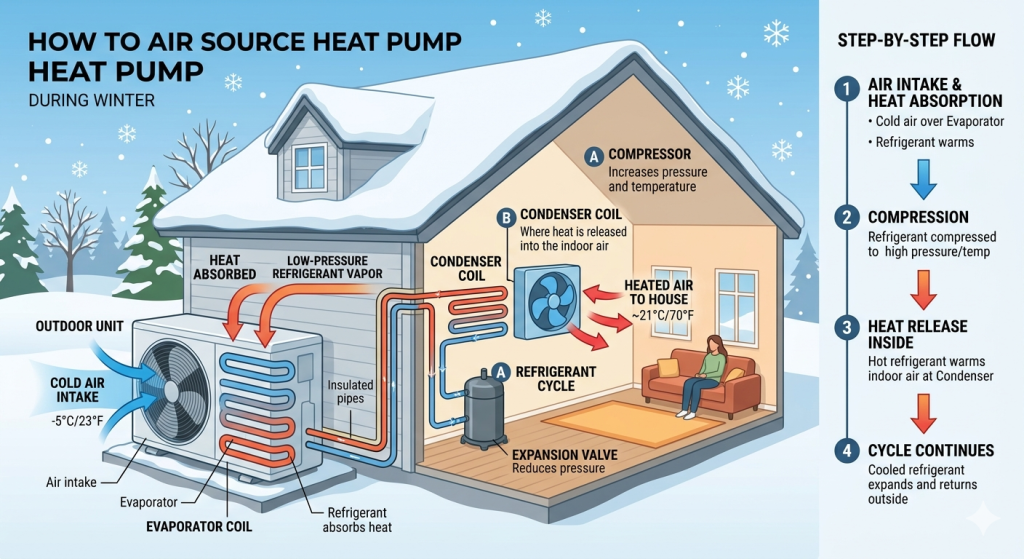
A heat pump operates through four main stages:
The system absorbs heat from an external source (air, ground, or water). Even in cold weather, there is still some heat energy available in the environment.
A refrigerant fluid inside the system absorbs this heat and passes through a compressor. The compressor increases the pressure and temperature of the refrigerant, turning it into a high-energy gas.
The heated refrigerant flows through a heat exchanger inside your home, releasing warmth into your indoor heating system—whether that’s radiators, underfloor heating, or warm air systems.
After releasing heat, the refrigerant cools down and returns to its liquid state. It then cycles back to absorb more heat, repeating the process continuously.
Types of Heat Pumps
Air Source Heat Pumps (ASHP)
Air source heat pumps are the most widely used option for residential properties due to their affordability and ease of installation.
How They Work
These systems extract heat from the outside air using a fan and heat exchanger. Even when temperatures drop below freezing, modern ASHPs can still capture usable heat.
Key Benefits
- Lower installation cost compared to other systems
- Suitable for most homes
- Can provide both heating and cooling
- Compact and easy to install
- Considerations
- Efficiency may slightly decrease in extremely cold climates
- Outdoor unit requires adequate space and ventilation
Best For: Existing homes and homeowners looking for a cost-effective upgrade.

Ground Source Heat Pumps (GSHP)
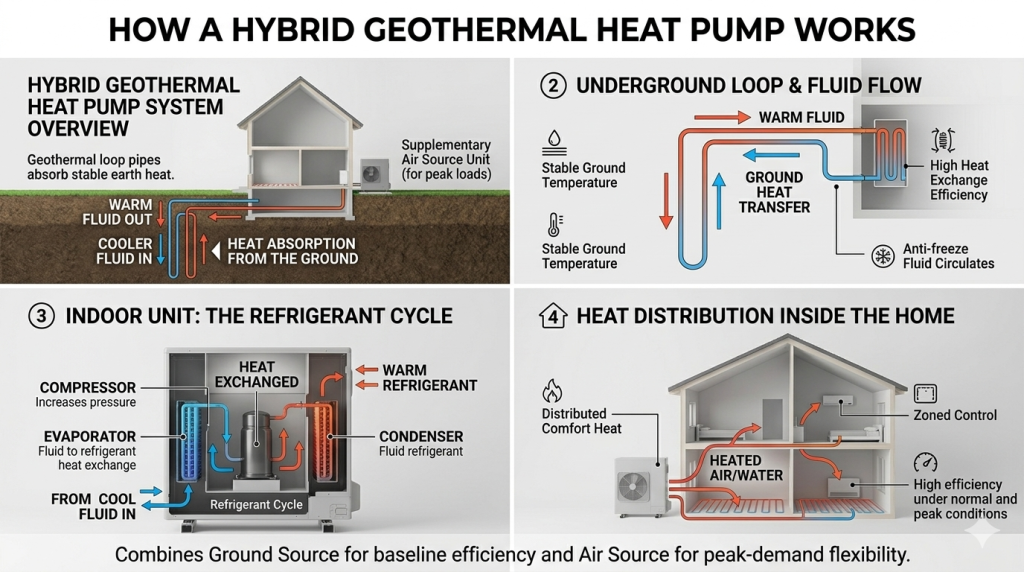
Ground source heat pumps, also known as geothermal systems, use heat stored in the ground to provide consistent and efficient heating.
How They Work
Pipes (called ground loops) are buried underground, where temperatures remain stable year-round. A fluid circulates through these pipes, absorbing heat from the earth and transferring it indoors.
Key Benefits
- Extremely high efficiency and performance
- Stable output regardless of weather conditions
- Lower long-term operating costs
- Longer lifespan than other systems
- Considerations
- Higher upfront installation cost
- Requires significant outdoor space for ground loops
- Installation can be more complex and time-consuming
Best For: New builds, large properties, or homeowners planning long-term energy savings.
Hybrid Heat Pump Systems
Hybrid systems combine a heat pump with a traditional heating system, such as a gas or oil boiler.
How They Work
The heat pump operates as the primary heating source during mild weather. When temperatures drop significantly, the system automatically switches to the boiler for additional support.
Key Benefits
- Flexible and reliable in all weather conditions
- Optimizes energy use for cost efficiency
- Ideal for homes not fully suited to standalone heat pumps
- Considerations
- Still relies partially on fossil fuels
- Slightly more complex system setup
Best For: Older homes or properties with existing boiler systems.
Why Air Source Heat Pumps Are Ideal for Homes in Swords
For most homeowners in Swords, air source heat pumps offer the best balance of cost, efficiency, and practicality.
Climate Compatibility
The relatively mild climate makes ASHPs highly effective, as they perform well even in cooler temperatures without extreme efficiency loss.
Lower Installation Costs
Compared to ground source systems, ASHPs require less groundwork and can be installed quickly, making them more accessible for homeowners.
Space Efficiency
They don’t require extensive outdoor land—just enough space for an external unit—making them ideal for urban and suburban homes.
Energy Savings
With rising energy prices, ASHPs provide a cost-effective way to reduce heating bills while maintaining comfort.
Frequently asked questions
Most heat pumps have a lifespan of 15 to 20 years, but this can vary depending on the type of system, usage patterns, and maintenance levels. Ground source heat pumps often last longer—sometimes up to 25 years for indoor components—because they operate under more stable conditions.
Regular maintenance plays a crucial role in extending lifespan. Simple actions like cleaning filters, checking refrigerant levels, and scheduling annual professional servicing can prevent wear and tear. Additionally, proper installation ensures the system isn’t overworked, which significantly improves durability.
Yes, modern heat pumps are specifically engineered to perform efficiently even in cold climates. Advanced air source heat pumps can extract heat from the air at temperatures as low as -15°C to -25°C, depending on the model.
While efficiency may slightly decrease in extreme cold, many systems include features like variable-speed compressors and defrost cycles to maintain performance. In particularly harsh conditions, a backup heating system (or hybrid setup) can provide additional support, ensuring consistent indoor comfort throughout winter.
Heat pumps are generally very quiet and are designed with noise reduction in mind. Most systems produce sound levels between 40–60 decibels, which is comparable to a refrigerator, dishwasher, or gentle background conversation.
The outdoor unit may emit a low hum during operation, but proper placement—such as away from bedroom windows or neighbouring properties—can minimize any disturbance. Modern models also include noise-dampening technology, making them suitable even for densely populated residential areas.
Yes, a heat pump can replace a traditional boiler, but some adjustments may be needed to ensure optimal performance. Heat pumps operate at lower temperatures than conventional boilers, so your home’s heating system must be compatible.
Common upgrades may include:
Improved insulation to retain heat more effectively
Larger or upgraded radiators to distribute lower-temperature heat
Underfloor heating systems, which pair exceptionally well with heat pumps
The installation of a heat pump typically takes 1 to 3 days for standard air source systems. However, the exact duration depends on factors such as property size, system complexity, and whether upgrades are required.
A basic installation with minimal changes can often be completed within a day. More complex projects—such as integrating underfloor heating, upgrading radiators, or installing ground source systems—may take several days to a week.
The process usually includes site preparation, system installation, testing, and final setup. Professional installers aim to minimize disruption while ensuring the system is fully optimized before handover.